

Chlorine has been used in municipal wastewater treatment since the early 20th century but it wasn’t until the Federal Water Pollution Control Act of 1972 that regulations were put in place to establish standards for wastewater treatment and the quality of effluent discharged into the environment. Residual chlorine can make its way into the environment via treated wastewater and can be toxic to both plant and animal life. In response, some facilities have installed dechlorination equipment to reduce residual chlorine levels.
What is Dechlorination?
The dechlorination process typically involves the use of a reducing chemical such as sodium bi-sulfite (NaHSO³) or sulfur dioxide (SO²). These chemicals require special provisions for handling, storage and emergency response training. In the last step of wastewater treatment by a plant using chlorine treatment, sodium bi-sulfate is often dosed into the wastewater in a dechlorination basin. To properly manage residual chlorine, effluent is treated with sodium bi-sulfate which must be thoroughly mixed and have the correct amount of contact time to be effective. Precise dosing and control of the reducing chemical is crucial to achieve the desired result.
The History of Municipal UV Water Treatment
Regulations around residual chlorine accelerated the development and adoption of UV (ultraviolet light) for treating municipal wastewater. In 1986, the USEPA Design Manual: Municipal Wastewater Disinfection was published. It included comprehensive pilot data on UV systems and design guidelines for the application of this rapidly growing technology.
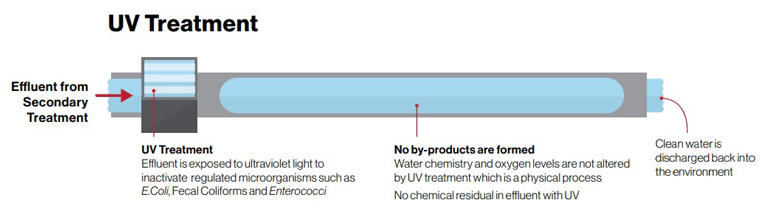
UV light is an effective physical treatment alternative that will not create by-products or discharge a chemical residual which can impact the environment.
The Cost Benefits of UV Wastewater Treatment
The initial capital expense and the operating expenses over a finite length of time (typically 20 years) can be added together to determine the total cost of implementation.
Chlorine | Sodium Hypochlorite | UV Treatment | |
|---|---|---|---|
Chemical Supplies | $ $ $ Purchase and delivery of chlorine gas cylinders | $ $ $ $ $ $ |
Loading video...
UV Savings Calculator
Discover a tool to help you understand the operating expense of a UV system
How Does UV Treatment Work?
UV treatment uses a fundamentally different process than chemical-based systems. Clarified wastewater, typically secondary effluent, is directed through open channels where it flows past a series of ultraviolet lights that are submerged in the effluent. As microorganisms in the water flow past the array of UV lamps, they are exposed to ultraviolet light at a wavelength of typically 254 nm (inactivation zone). These powerful photons in the UV-C range alter the genomic structure of microbes rendering the microbe unable to reproduce and therefore becomes non-infectious.
Benefits of Choosing UV for Municipal Water Treatment
UV provides effective inactivation of microorganisms through physical treatment of water. The retention time required to achieve inactivation is usually in the range of a few seconds which reduces the physical footprint and capital costs of installation for UV systems.
Chlorine Treatment | UV Treatment | |
|---|---|---|
No Treatment By-products (DBP’s) |
The top things that you don’t have to worry about with UV
Loading video...
Comparing Different Types of Municipal Wastewater Treatment
Chlorine | Sodium Hypochlorite | UV Treatment | |
|---|---|---|---|
Transportation | Chlorine gas is delivered to the treatment plant by truck or train. | Has a limited shelf life, requiring frequent transportation and deliveries. | Lamps are typically delivered once or twice a year. |
Is your plant interested in converting to UV treatment?
Contact us today to speak to an expert about your project
UV for Municipal Wastewater
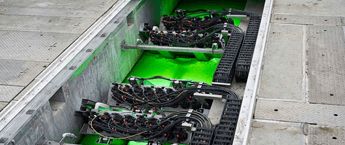
Municipal UV water treatment systems are simple and straightforward to operate.

Potable & Non-Potable Reuse
Many water providers are turning to reuse as the solution to their water supply and quality challenges.
UV for Municipal Drinking Water
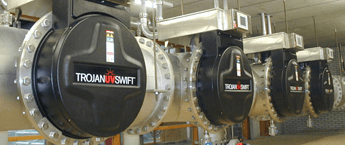
UV light provides rapid, effective inactivation of microorganisms through a physical process.