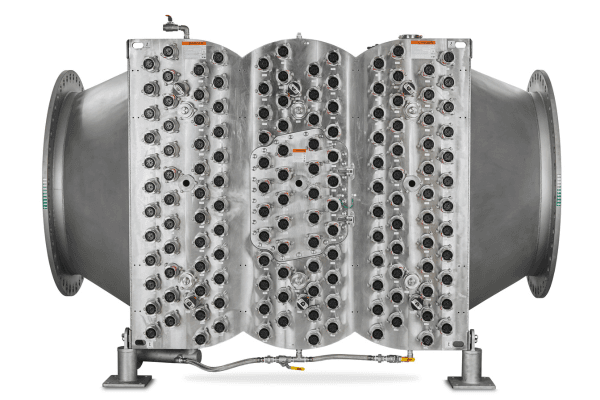


Learn how a water provider in New Jersey cost-effectively incorporated low-pressure UV technology for advanced oxidation of 1,4-dioxane along with carbon filtration to co-treat other forever chemicals like PFAS.
Groundwater utilities across New Jersey and beyond are facing increasing pressure to address emerging contaminants such as 1,4-dioxane and PFAS. This white paper examines how the Merchantville–Pennsauken Water Commission (MPWC) proactively responded to these challenges by implementing three full-scale UV advanced oxidation process (UV AOP) systems to treat 1,4-dioxane in groundwater. The whitepaper explains why conventional treatment methods such as activated carbon and reverse osmosis are often ineffective for 1,4-dioxane and details how UV AOP uses ultraviolet light and hydrogen peroxide to break down contaminants at the molecular level rather than simply removing them from the water. It also highlights the science behind system design, including the impact of nitrate concentrations on treatment efficiency and the advantages of low-pressure UV technology for optimizing performance and reducing energy consumption. The whitepaper also explores how MPWC combined UV AOP with downstream granular activated carbon (GAC) treatment to create a comprehensive solution capable of addressing both 1,4-dioxane and PFAS while maintaining operational flexibility and regulatory compliance. Real-world design considerations, performance targets, and lessons learned demonstrate how utilities can implement scalable, future-ready treatment strategies for complex groundwater contamination challenges. To discover the full technical details, system design insights, and performance results, download the whitepaper and learn how a data-driven, multi-barrier treatment approach can help utilities confidently tackle emerging contaminants today and in the future.

Download the Whitepaper
Have questions?
Call us at 1 (888) 220-6118 or complete the form below.
UV Solutions
To address water supply and quality challenges, many providers are turning to advanced water treatment processes to enable wastewater reuse and drinking water remediation. TrojanUV systems support these efforts by treating water to stringent standards, using UV advanced oxidation to break down specific contaminants like 1,4-dioxane and NDMA, ensuring the water is high-quality and useable.