

Water resources are under stress due to increasing population, changing rainfall patterns, widespread pollution, and a variety of other factors. For this reason, water providers must strive to make the most of every available water source, even those that have been impacted by contamination.
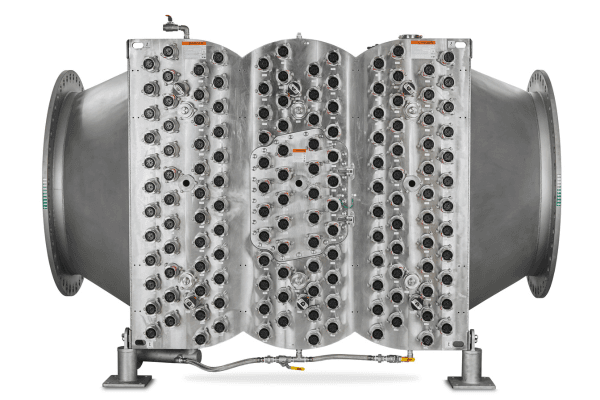
TrojanUV advanced oxidation systems provide water confidence and help restore and preserve precious water supplies. These systems are enabling water suppliers to cost-effectively treat chemical and microbial contaminants in drinking water, wastewater reuse, and groundwater remediation applications. The TrojanUVSwift®ECT provides reliable delivery of UV energy to safeguard water against microorganisms and oxidize environmental contaminants.
Dual treatment action provides UV treatment and contaminant breakdown
Innovative process delivers microbial inactivation of Cryptosporidium, Giardia, and Adenovirus and breaks down environmental contaminants 1,4-dioxane, NDMA, geosmin and MIB.
Cost-effective

Download the Brochure
PDF Available in 4 Languages
Have questions?
Call us at 1 (888) 220-6118 or complete the form below.
Optimized chamber technology makes the advanced oxidation process (UV AOP) cost-effective for a wide range of applications.
Compact design reduces capital costs
Small footprint relative to ozone and other technologies simplifies installation and significantly reduces capital costs.
Well suited to seasonal treatment
Effectively treats taste and odor problems related to algae blooms occurring in warm summer and fall months.
Rapid, by-product-free treatment
Single unit process treats water almost instantly, without forming bromate, other by-products, or hazardous gases.
Intuitive operation
Designed for minimal operator involvement.
UV Solutions
To address water supply and quality challenges, many providers are turning to advanced water treatment processes to enable wastewater reuse and drinking water remediation. TrojanUV systems support these efforts by treating water to stringent standards, using UV advanced oxidation to break down specific contaminants like 1,4-dioxane and NDMA, ensuring the water is high-quality and useable.