

There is a growing need to protect the world’s water supply from chemicals. Recent research has shown that a wide variety of chemicals exist at trace concentrations in streams, lakes, rivers, and in groundwater throughout the world.
The term “environmental contaminants” refers to chemicals present in soil, in air, and in water. These compounds may come directly from human sources such as industrial manufacturing, agricultural run-off, or wastewater discharge, or they may originate from natural sources, such as the taste- and odor-causing chemicals in water generated by algae and bacteria blooms.

Download the Brochure
Have questions?
Call us at 1 (888) 220-6118 or complete the form below.
1,4-Dioxane
Taste- and odor-causing compounds (e.g., geosmin and MIB)
N-nitrosodimethylamine (NDMA)
Pharmaceuticals and personal care products (PPCPs)
Pesticides and herbicides
Fuels and fuel additives (e.g., MTBE and BTEX)
Volatile Organic Compounds (VOCs) like PCE and TCE
Endocrine disruptor chemicals (EDCs)
Algal toxins (e.g., Microcystin)
These compounds can be treated either by ultraviolet (UV) light alone or by UV light combined with oxidizing radicals, referred to as the UV advanced oxidation process (UV AOP).
UV has been used successfully over the last century to treat drinking water and wastewater. That same technology is now applied to perform environmental contaminant treatment on a large-scale.
Cost-Effective
For certain contaminants, UV AOP is the only economical method of treatment. For example, NDMA and 1,4-dioxane cannot be fully treated with membrane technologies (including reverse osmosis), carbon adsorption, or air stripping.
Eliminates Residuals
UV AOP has the advantage of being a technology that breaks down contaminants into their elemental components. Other treatment technologies merely transfer the contaminant from one phase to another (e.g. air stripping: from water to air) – resulting in a potentially hazardous, contaminant-laden residual that requires further treatment or disposal.
UV Solutions
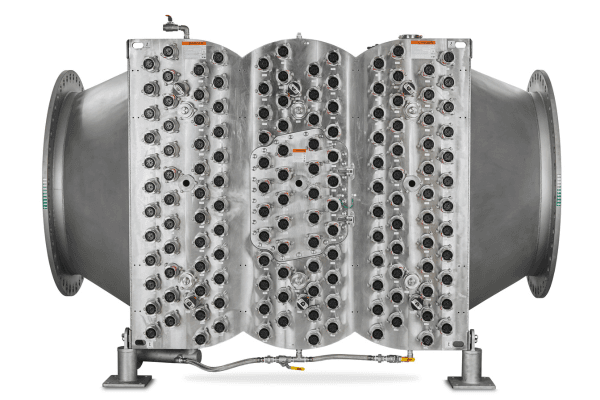
To address water supply and quality challenges, many providers are turning to advanced water treatment processes to enable wastewater reuse and drinking water remediation. TrojanUV systems support these efforts by treating water to stringent standards, using UV advanced oxidation to break down specific contaminants like 1,4-dioxane and NDMA, ensuring the water is high-quality and useable.