


For more than 100 years, most public water supplies in the US have been treated with chlorine. Now, more than 40% of utilities have made the switch from chlorine to chloramine (a mixture of chlorine and ammonia), largely due to its advantages as a longer-lasting residual and that it produces fewer disinfection by-products. That said, chloramines have corrosive properties that can damage metal pipes and, over time, degrade rubber, such as O-rings, gaskets, and seals. As a result, chloramines can damage process equipment, such as downstream membranes.
Ultraviolet (UV) technology using low-pressure lamps is a highly effective, versatile, reliable method for chloramine reduction. Studies have demonstrated conclusively that chloramine residuals up to 4 ppm can be successfully reduced to < 0.02 ppm by the application of UV light.
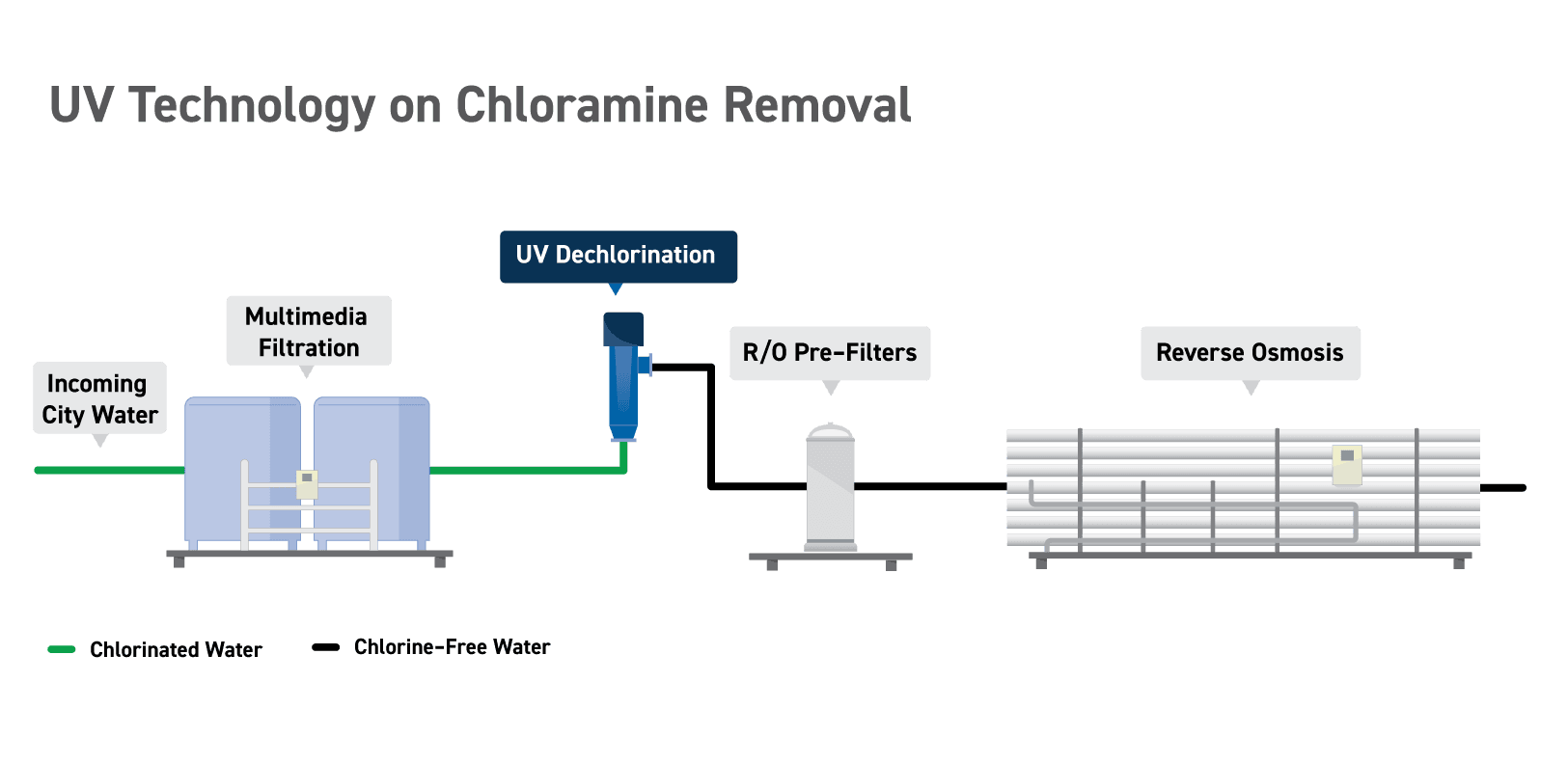
Although chloramine is a weaker disinfectant than chlorine, it is more stable, which extends its disinfectant benefits throughout a water utility's distribution system. Unfortunately, though they help address the issue of microbiological contaminants, they are also known to be challenging to remove and are a known irritant with corrosive properties.
From a water treatment equipment optimization point of view, since chloramine remains active longer in the water and does not dissipate by itself, downstream membranes can be damaged by the oxidizing power of chloramines. For municipal water utilities now using chloramines rather than free chlorine to treat water, this reduces membrane performance and lifetime.
Ultraviolet treatment using photolysis is rapidly growing in popularity for reducing chloramines in water. The breakdown products from treating monochloramine with UV are primarily nitrate, nitrite, nitrogen, and chloride ions, which are non-hazardous. At typical pH and dissolved oxygen levels in municipal treated waters, ammonia formation is negligible. A key benefit of UV technology is the ability to treat free chlorine and chloramine effectively, eliminating the concern regarding sudden changes in municipal water treatment impacting your water quality.
UV technology has been successfully demonstrated in the industrial segment for being an ideal solution for chloramine reduction, given the following benefits:
Small physical footprint
Achieving chloramine levels down to parts per million (ppm)
Meeting sustainable and/or “Net Zero” objectives
Drastically reduced downtime
Lower capex and opex compared to only using catalytic carbon
Robust protection against chlorine spikes/fluctuations, ensuring long life of downstream equipment and consistent water quality
UV technology offers a comprehensive solution for chloramine reduction, and can work synergistically with activated carbon. It operates efficiently across various CIP cycle temperatures, which helps reduce waste, lower costs, and minimize the amount of carbon needed over time. With the ability to reduce chloramine residuals by 99.5%, UV significantly decreases the workload on catalytic carbon.
This combination also results in lower levels of organics, such as THMs, in the feed ingredient water, leading to improved water quality and reducing the need for frequent carbon touch-ups. Additionally, UV mitigates the risk of bacterial contamination in carbon beds, saving time, resources, and costs associated with frequent carbon sanitations.

Learn more about using UV technology to reduce chlorine and chloramines in water.
These reducing agents react with oxygen in the air and water and must be reconstituted frequently due to loss of solution strength. This method also requires a significant footprint, occupying valuable factory space, which may be particularly important for skid mounted equipment.
Ultraviolet light is an effective way to reduce chloramines. This method uses ultraviolet energy to turn free chlorine and chloramines into inorganic compounds such as chloride, nitrite, and nitrate ions.
Both medium-pressure (polychromatic) and low-pressure (monochromatic)UV solutions are used for chloramine reduction. However, low-pressure UV lamps utilize a fraction of the energy compared to medium-pressure lamps.
Low-pressure lamps can emit UV radiation only at a wavelength of 253.7 nm. In contrast, medium-pressure UV systems emit a wide range of wavelengths within the germicidal UV range, ranging from 200 to 600 nm. The term “pressure” refers to the vapour pressure of mercury in the lamp.
Beyond inactivating pathogens, low-pressure UV can reduce monochloramine (NH2Cl) through a process called photolysis. In this process, the monochloramine molecule is ideally suited to absorb the UV output from a low-pressure lamp, which leads to the efficient breakdown of monochloramine. Low-pressure UV systems typically cost significantly less than medium-pressure systems, both in capex and opex. Low-pressure UV lamps operate at a lower temperature than medium-pressure lamps and therefore last longer and use less energy - requiring less frequent replacement of bulbs. All of this contributes to a much more affordable system compared to medium-pressure UV.
Another advantage that comes with less energy, less heat, and longer lamp life is that low-pressure UV can better handle intermittent flow. Medium-pressure systems require constant flow, as the lamps release a lot of heat (medium-pressure UV lamps have wall temperature of 700 to 900C). This usually means the lamps have a shorter useful lifespan. Cooling is necessary, and if water is not constantly flowing, it can shorten the lifespan of the lamps even more. This contributes to higher operating costs.
Perhaps the most important disadvantage of medium-pressure UV compared to low-pressure UV is its cost. With energy requirements of approximately 6x higher than low-pressure for the same level of monochloramine reduction, this leads to a higher opex. In addition, with medium-pressure systems expensive to purchase and operate (energy) and expensive to maintain (lamp cleaning and replacement), this leads to a higher total cost of ownership compared to low-pressure systems.
Yes. Operating installations exist today using ultraviolet (UV) technology with low-pressure lamps to reduce chloramines in water. UV is a robust, versatile, reliable approach to address numerous requirements in industrial water applications, including chloramine reduction. UV treatment is an increasingly popular dechlorination technology with none of the above drawbacks of carbon or chemicals. Using UV treatment with low-pressure lamps for both free chlorine and/or combined chlorine (chloramines) reduction results in low levels of harmless byproducts.
The UV dosage required for dechlorination depends on a number of factors including the pH, initial and desired chloramine concentration and background level of organics. Given the selection of right UV solution is a confluence of multiple factors and variables, it is recommended to have an in-depth techno-commercial discussion before selection of UV for a pharmaceutical or a beverage plant.
Note that the typical UV dose for reduction of chloramines are several times higher than that for normal microbial inactivation. As a result, membranes stay cleaner longer because the dose for dechlorination is so much higher than the normal dose used if dechlorination was not the goal. Additional benefits of using UV for dechlorination are:
High levels of UV treatment
Elimination of the safety hazards associated with handling chemicals
Elimination of risk of biofouling and introducing microorganisms into RO (via GAC or injection of neutralizing chemicals); and
Small footprint
Easier to meet Net Zero goals without “wasted” water and energy for backwashing and hot water sanitization
Overall improved water quality at point of use
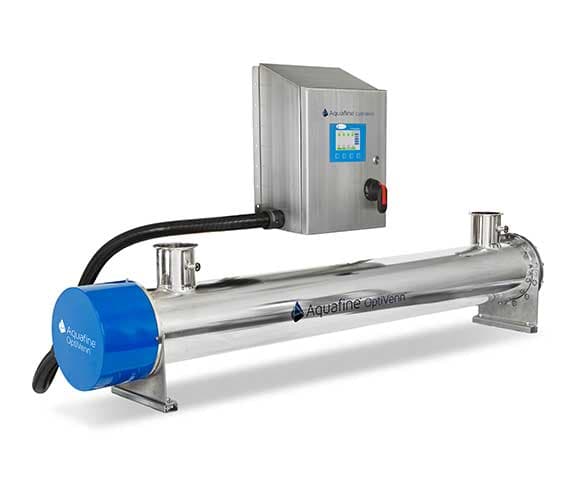
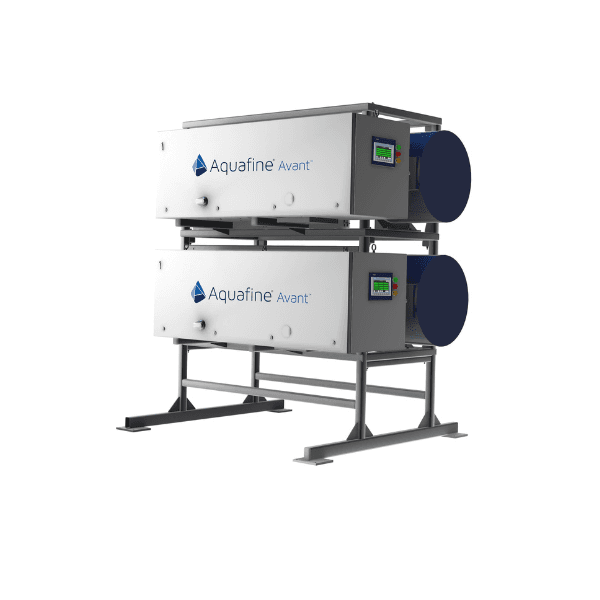
UV reactors designed for chloramine treatment are generally easy to install and operate (two plumbing connections per unit and one electrical hook-up). They are equipped with a user-friendly operator interface, alarm and system status indication and designed for ease of maintenance (typically requiring only annual lamp changeout).
Typical UV system components include:
A stainless steel UV reactor
UV lamps that are properly secured inside quartz sleeves, easing installation, replacement, and maintenance
Quartz sleeves with sufficiently high transmission rates to deliver the UV energy produced by UV lamps
Intensity sensors to monitor the UV intensity passing through the water. These sensors can be connected to alarm systems to alert the operator in case of low UV intensity. The operator usually has easy access to these sensors for necessary installation, replacement, calibration, and maintenance
Electronic ballasts
Multiple factors, such as pH (Palin, 1950), quantum yield, UV dose, UVT of water, and UV wavelength, affect monochloramine reduction. The literature-reported range for UV dose per log (90%) removal with low-pressure Hg lamps, emitting UV at 253.7 nm, is 3600 to 4000 mJ/cm². Given the selection of right UV solution is a confluence of multiple factors and variables, it is recommended to have an in-depth techno-commercial discussion before selection of UV for a pharmaceutical or a beverage plant.


Our UV systems can work alone or alongside carbon to treat chloramines and chlorine


